


Egg Freezing Explained: How the Process Works, Step by Step
Egg freezing is becoming an increasingly discussed fertility preservation option for women who want to keep the possibility of pregnancy open for the future. Some women consider egg freezing because they are not ready to start a family yet, while others may need fertility preservation before certain medical treatments or procedures.
But before deciding to freeze your eggs, it is important to understand what the treatment actually involves.
How does egg freezing work? What tests are needed? How many injections are required? Is egg retrieval painful? How long can eggs remain frozen? And what happens when you want to use those eggs for pregnancy?
If you are exploring egg freezing in Varanasi or looking for an IVF center in Varanasi for fertility preservation, this detailed guide will help you understand the complete process—from your first fertility consultation to the future use of frozen eggs.
What Is Egg Freezing?
Egg freezing, medically known as oocyte cryopreservation, is a fertility preservation procedure in which eggs are collected from a woman's ovaries, frozen at very low temperatures and stored for possible future use.
A woman's fertility naturally changes with age. Both the quantity and reproductive potential of eggs generally decline over time.
Egg freezing allows eggs to be preserved at the age at which they are retrieved.
If pregnancy is desired later, the frozen eggs can be thawed, fertilized in an IVF laboratory and potentially used to create embryos for transfer into the uterus.
However, there is an important distinction:
Egg freezing may preserve a future fertility option, but it cannot guarantee pregnancy or a baby.
Future success depends on multiple factors, including age at the time of freezing, number of mature eggs stored, egg survival after thawing, fertilization, embryo development and other reproductive factors.
Why Do Women Consider Egg Freezing?
There is no single reason for choosing fertility preservation.
Women may consider egg freezing when:
- They want children in the future but are not currently ready for pregnancy.
- They wish to delay pregnancy for personal, professional or educational reasons.
- They do not currently have the right circumstances for starting a family.
- Certain medical treatments may potentially affect ovarian function.
- Ovarian surgery or another medical procedure is being planned.
- A fertility specialist identifies circumstances where fertility preservation may be worth discussing.
- They want to understand their fertility preservation options before age-related fertility decline becomes more significant.
The decision should always be individualized rather than based only on age or social pressure.
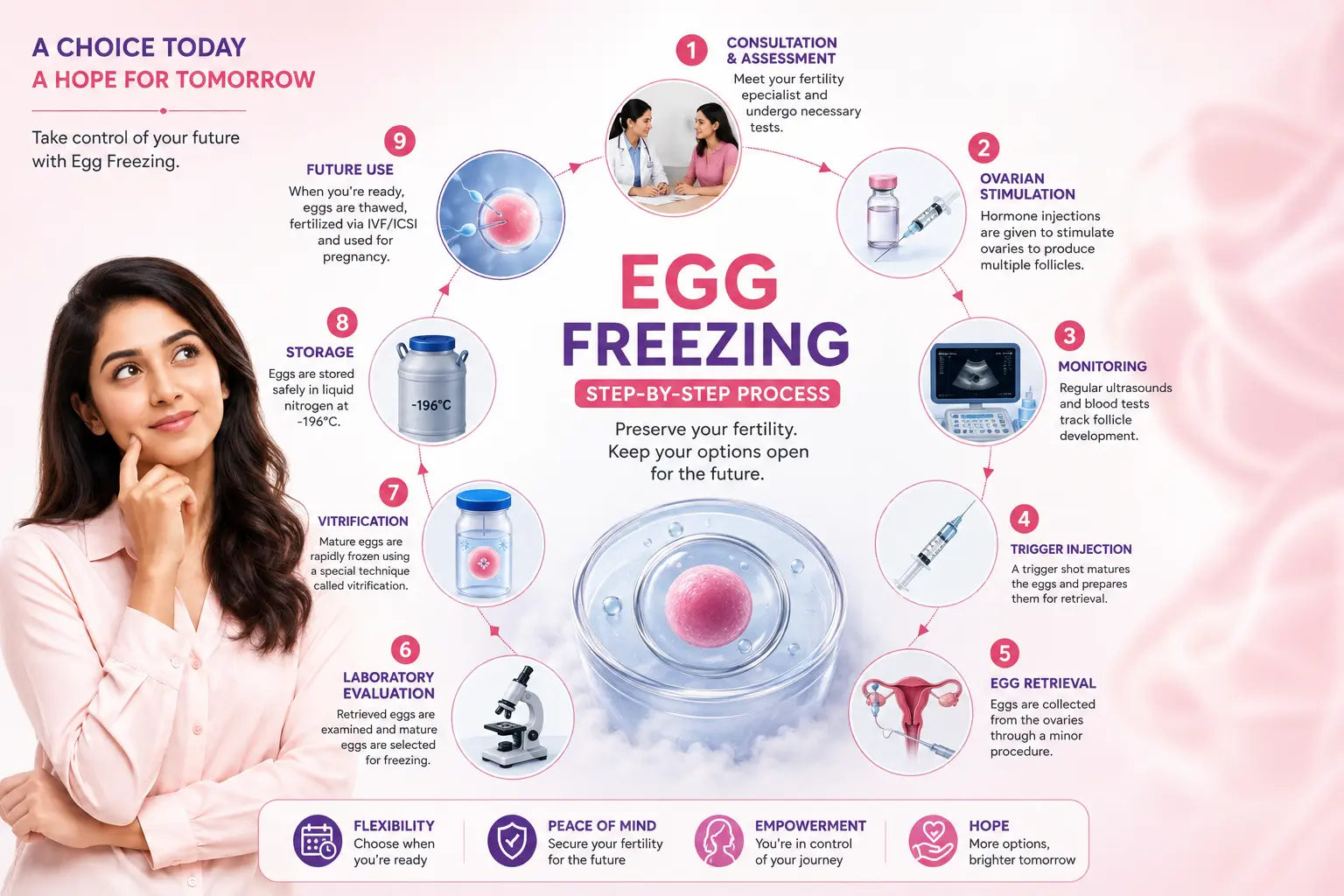
Egg Freezing Process: Step-by-Step
The complete egg freezing process can broadly be divided into these stages:
- Fertility consultation
- Ovarian reserve assessment
- Ovarian stimulation
- Follicle monitoring
- Trigger injection
- Egg retrieval
- Laboratory assessment
- Egg vitrification
- Cryogenic storage
- Thawing and IVF when pregnancy is desired
Let's understand each step in detail.
Step 1: Consultation With a Fertility Specialist
The first step is a detailed consultation with a fertility specialist.
During the appointment, the doctor may discuss:
- Your age
- Menstrual cycle
- Previous pregnancies
- Fertility history
- Previous ovarian or pelvic surgery
- Existing medical conditions
- Current medications
- Family history
- Previous fertility treatments
- Your future pregnancy plans
If you are specifically searching for a fertility specialist in Varanasi for egg freezing, choose a centre where counselling, ovarian stimulation, egg retrieval and embryology support can be coordinated appropriately.
The purpose of the consultation is not merely to say whether egg freezing is possible.
A good consultation should help answer a more important question:
What can egg freezing realistically offer in your individual situation?
Step 2: Fertility Tests Before Egg Freezing
Before starting treatment, your fertility specialist may recommend tests to assess your ovarian reserve and reproductive health.
AMH Test
Anti-Müllerian Hormone (AMH) is commonly used as one indicator of ovarian reserve.
AMH can help doctors estimate how the ovaries may respond to stimulation medication.
However, AMH alone should not be interpreted as a fertility score or a direct prediction of natural pregnancy.
Can You Freeze Eggs With Low AMH?
Potentially, yes.
A low AMH result does not automatically mean egg freezing is impossible.
It may indicate that fewer eggs could be obtained during stimulation, but the actual response varies between women.
The doctor may consider AMH together with:
- Age
- Antral follicle count
- Menstrual history
- Previous response to stimulation
- Other reproductive health factors
Women concerned about low ovarian reserve may therefore benefit from a detailed fertility evaluation rather than making decisions based on a single AMH report.
Antral Follicle Count (AFC)
A transvaginal ultrasound can be used to count small follicles present in the ovaries.
This is known as the antral follicle count.
AFC, AMH, age and medical history together can help the fertility specialist estimate ovarian response and select an appropriate stimulation protocol.
Step 3: Ovarian Stimulation With Fertility Injections
In a natural menstrual cycle, several follicles may initially start developing, but usually only one egg reaches ovulation.
During an egg-freezing cycle, fertility medications are used to encourage multiple follicles to develop simultaneously.
This increases the possibility of retrieving several mature eggs in one cycle.
How Long Are Egg-Freezing Injections Required?
Ovarian stimulation commonly takes approximately 8–14 days, although the duration varies according to individual ovarian response and the treatment protocol.
There is no universal dose.
Your fertility specialist may determine medication based on factors including:
- Age
- AMH
- AFC
- Body response
- Previous treatment history
- Ultrasound findings
- Are Egg-Freezing Injections Painful?
Most fertility injections are administered under the skin using relatively small needles.
Some women experience very little discomfort, while others may notice:
- Mild injection-site pain
- Bruising
- Abdominal bloating
- Pelvic heaviness
- Breast tenderness
- Fatigue
- Temporary mood changes
Symptoms vary considerably from person to person.
Severe or unexpected symptoms should always be reported to the treating fertility team.
Step 4: Monitoring Follicle Growth
Regular monitoring is an important part of the egg-freezing procedure.
During ovarian stimulation, the fertility specialist may perform ultrasound scans to monitor follicle development.
Blood tests may also be advised when clinically appropriate.
Monitoring helps determine:
- How well the ovaries are responding
- How many follicles are developing
- Whether medication doses need adjustment
- When the follicles are approaching maturity
- When the trigger injection should be administered
Treatment is therefore adjusted according to your actual response rather than following exactly the same schedule for every patient.
Step 5: Trigger Injection
When the follicles have reached an appropriate stage, the fertility specialist advises a trigger injection.
The trigger helps the eggs complete the final stages of maturation before retrieval.
Egg retrieval is commonly planned around 34–36 hours after the trigger, although the exact timing depends on the protocol.
Following the clinic's timing instructions is important.
Step 6: Egg Retrieval Procedure
Egg retrieval, also known as oocyte retrieval, is the stage at which eggs are collected from the ovaries.
The procedure is generally performed under sedation or anaesthesia according to the patient's condition and clinic protocol.
How Are Eggs Retrieved?
The doctor visualizes the ovaries using ultrasound.
A fine needle is guided toward the ovarian follicles, and follicular fluid is collected.
The fluid is immediately examined in the embryology laboratory to identify eggs.
Egg retrieval itself is generally a relatively short procedure, although preparation, sedation and post-procedure observation require additional time.
Is Egg Retrieval a Major Surgery?
Egg retrieval is not generally an open abdominal operation.
Usually there is:
- No abdominal incision
- No external stitches
- No large surgical wound
Most patients can return home after an appropriate observation period, depending on their medical condition and the advice of their fertility team.
Step 7: The Embryology Lab Examines the Eggs
One common misconception is that every follicle visible on ultrasound will provide a mature egg.
That is not necessarily the case.
After retrieval, embryologists assess the collected eggs.
The numbers may differ at different stages:
Follicles observed → Eggs retrieved → Mature eggs suitable for freezing
Not every retrieved egg will necessarily be mature enough for cryopreservation.
This is why laboratory quality and embryology expertise are important considerations when evaluating an IVF and fertility center in Varanasi for egg freezing.
Step 8: Egg Freezing Through Vitrification
Mature eggs suitable for preservation are frozen using a technique known as vitrification.
Vitrification involves extremely rapid cooling.
Specialized cryoprotective solutions are used before freezing to help reduce damaging ice-crystal formation within the egg.
The vitrified eggs are then stored under carefully controlled cryogenic conditions.
Step 9: How Long Can Eggs Stay Frozen?
Eggs stored correctly under cryogenic conditions do not continue ageing in the same way eggs remaining in the ovaries do.
However, storage duration, consent requirements and other conditions may depend on current regulations and clinic policies.
Before choosing egg freezing, ask the fertility centre about:
- Storage policy
- Annual storage charges
- Consent requirements
- Renewal procedures
- Applicable regulations
- What happens if you no longer wish to store the eggs
- Step 10: What Happens When You Want to Become Pregnant?
If you decide to use your frozen eggs in the future, the eggs are carefully thawed in the IVF laboratory.
Not every frozen egg will necessarily survive the thawing process.
Eggs that survive appropriately can then proceed to fertilization.
How Are Frozen Eggs Fertilized?
Frozen eggs are generally used as part of an IVF treatment process.
Fertilization may involve ICSI (Intracytoplasmic Sperm Injection), where a selected sperm is introduced directly into the egg.
If fertilization occurs successfully, the resulting embryos are cultured in the laboratory.
A suitable embryo may subsequently be selected for embryo transfer into the uterus.
The overall journey can therefore be understood as:
Frozen Egg → Thawing → Egg Survival → Fertilization → Embryo Development → Embryo Transfer → Implantation → Pregnancy
There can be attrition at each stage.
This is why the number of eggs frozen should never be considered equal to the number of future babies.
What Is the Best Age for Egg Freezing?
There is no single “best age” suitable for every woman.
However, age at the time the eggs are frozen is one of the most important factors influencing their future reproductive potential.
Egg quantity and quality generally decline with increasing reproductive age.
Freezing eggs at a younger age may therefore provide better reproductive potential than freezing them considerably later.
But this does not mean every young woman should freeze her eggs.
The decision should consider:
- Current age
- Ovarian reserve
- Future family plans
- Medical history
- Expected ovarian response
- Personal circumstances
- Financial considerations
A fertility specialist can help interpret these factors together.
How Many Eggs Should You Freeze?
There is no magic number of eggs that guarantees pregnancy.
The number needed depends on several factors:
- Age at egg freezing
- Number of mature eggs retrieved
- Egg quality
- Survival after thawing
- Fertilization rate
- Embryo development
- Future sperm factors
- Uterine health
- Other reproductive factors
For this reason, some women may achieve their planned number of stored eggs after one cycle, while others may discuss more than one egg-freezing cycle.
Your fertility specialist can provide an individualized estimate, but no responsible clinic should promise a baby based solely on a particular number of frozen eggs.
Does Egg Freezing Reduce Your Future Egg Reserve?
This is another common concern.
During each menstrual cycle, several follicles begin developing naturally. Usually only one becomes dominant and ovulates, while many of the others stop developing.
Ovarian stimulation supports the development of more follicles from that recruited group.
Egg freezing should therefore not simply be understood as removing eggs that would otherwise have been used in future monthly cycles.
Can You Still Get Pregnant Naturally After Egg Freezing?
Yes, egg freezing does not mean that you must use frozen eggs to become pregnant in the future.
If natural conception is possible when you decide to start a family, you may still try naturally according to your doctor's advice.
Some women who freeze eggs never ultimately need to use them.
Frozen eggs provide an additional fertility option rather than automatically replacing natural conception.
Does Egg Freezing Guarantee Pregnancy?
No.
This is one of the most important facts patients should understand.
Egg freezing preserves eggs—it does not preserve a guaranteed pregnancy.
Future success can be affected by:
- Age when eggs were frozen
- Number of mature eggs stored
- Egg survival after thawing
- Fertilization
- Embryo quality and development
- Sperm factors
- Uterine health
- Overall reproductive and medical health
This is why realistic counselling is an essential part of fertility preservation.
Possible Risks and Side Effects of Egg Freezing
Like other medical procedures, egg freezing has potential risks and side effects.
These may include:
- Temporary bloating
- Pelvic discomfort
- Medication side effects
- Injection-site reactions
- Ovarian hyperstimulation in some patients
- Bleeding or infection associated with retrieval, although uncommon
- Risks associated with sedation or anaesthesia
- Emotional stress
- Financial burden
- Fewer mature eggs than expected
- Eggs not surviving thawing
- Fertilization failure
- Embryos not developing as expected
- Treatment not resulting in pregnancy
Your fertility specialist should discuss the potential benefits and limitations before treatment begins.
Egg Freezing vs Embryo Freezing
Egg freezing and embryo freezing are not the same.
- Egg Freezing Embryo Freezing
- Unfertilized eggs are frozen Fertilized embryos are frozen
- Sperm is not required at freezing stage Sperm is required
- Fertilization happens later Fertilization happens before freezing
- Provides flexibility regarding future sperm source Egg and sperm genetic contribution is already established
- Eggs must survive thawing and then fertilize Embryos have already passed the fertilization stage
Which approach is more appropriate depends on the individual's medical and personal circumstances.
Egg Freezing in Varanasi: What Should You Look for in a Fertility Centre?
If you are considering egg freezing in Varanasi, choosing a fertility centre should involve more than simply comparing treatment prices.
Look at the complete fertility preservation pathway.
Important factors include:
Experienced Fertility Specialist
Your doctor should assess age, ovarian reserve, medical history and future reproductive goals before recommending treatment.
IVF and Embryology Laboratory
Egg freezing is highly dependent on laboratory processes, including handling, vitrification, storage and future thawing.
Individualized Ovarian Stimulation
Medication protocols should ideally be planned according to ovarian reserve and individual response.
Proper Monitoring
Ultrasound and appropriate clinical monitoring are important throughout stimulation.
Transparent Counselling
Patients should understand realistic expectations, potential risks, possible need for multiple cycles and future IVF requirements.
Cryopreservation and Storage Facilities
Ask how eggs are vitrified, stored, identified and monitored.
Clear Cost Information
Understand which expenses relate to treatment, medication, egg retrieval, freezing, storage and future use.
When searching for the best IVF center in Varanasi, these clinical and laboratory factors are more meaningful than choosing a centre based only on advertising claims.
How to Choose the Best IVF Center in Varanasi for Egg Freezing
People searching online for the best IVF center in Varanasi often focus primarily on success rates or treatment cost.
For egg freezing, however, you should ask more specific questions.
Before choosing a fertility clinic, consider asking:
- Does the centre routinely provide egg freezing and fertility preservation?
- Which vitrification technique is used?
- Who manages the embryology laboratory?
- How are frozen eggs stored and monitored?
- How does the clinic assess ovarian reserve?
- Will my stimulation plan be individualized?
- How frequently will I need monitoring?
- What happens if fewer eggs are retrieved than expected?
- What are the storage charges?
- How will the eggs eventually be thawed and fertilized?
- What costs will be involved when I decide to use them?
The best fertility clinic in Varanasi for you should be one that provides clear answers and individualized counselling rather than making unrealistic guarantees.
When Should You Consult a Fertility Doctor?
You do not have to wait until you are actively trying for pregnancy to speak with a fertility specialist.
A consultation may be useful if:
- You are considering delaying pregnancy.
- You want to understand your ovarian reserve.
- You have been told your AMH is low.
- You have a family history of early menopause.
- You are planning certain medical treatments.
- You may undergo ovarian surgery.
- You have questions about fertility preservation.
- You want to know whether egg freezing is appropriate for your age.
Women searching for a fertility doctor in Varanasi can specifically ask for a fertility preservation consultation rather than assuming that a fertility appointment is only for couples already experiencing infertility.
Egg Freezing Cost in Varanasi: What Does the Cost Include?
The egg freezing cost in Varanasi can vary because treatment is not identical for every patient.
Instead of looking only at one package price, ask whether the quoted amount includes:
- Fertility consultation
- AMH and other investigations
- Ultrasound monitoring
- Fertility injections
- Trigger medication
- Egg retrieval
- Anaesthesia or sedation
- Embryology laboratory charges
- Vitrification
- Cryogenic storage
- Annual storage charges
Also remember that using the eggs in the future may involve additional costs for:
- Egg thawing
- ICSI/IVF
- Embryo culture
- Embryo transfer
- Medications
- Additional investigations
A transparent fertility centre should explain these components before treatment.
Questions to Ask Your Fertility Doctor Before Egg Freezing
1. Is egg freezing suitable for me at my current age?
Age affects egg quality, but your overall assessment should also include ovarian reserve and medical history.
2. What are my AMH and antral follicle count?
Ask the doctor to explain what these results mean together rather than interpreting one test independently.
3. How many eggs might I retrieve?
Doctors can estimate ovarian response, but the exact number cannot be guaranteed before retrieval.
4. How many mature eggs should I ideally freeze?
The answer depends heavily on age and individual reproductive goals.
5. Could I require more than one cycle?
Some women may need to consider multiple stimulation cycles to store the desired number of mature eggs.
6. What vitrification technique does your laboratory use?
Understanding laboratory processes is important because egg freezing and thawing depend significantly on embryology expertise.
7. What happens when I eventually want to use my eggs?
Ask about thawing, ICSI, embryo culture and embryo transfer beforehand.
8. What is the total expected cost?
Ask for separate information about treatment, medications, freezing, storage and future IVF-related expenses.
Frequently Asked Questions About Egg Freezing
1. Where can I get egg freezing in Varanasi?
Egg freezing is provided by fertility and IVF centres with appropriate ovarian stimulation, egg retrieval, embryology, vitrification and cryostorage facilities. Before choosing a centre, consult a fertility specialist and ask specifically about its egg-freezing laboratory and storage protocols.
2. How do I choose the best IVF center in Varanasi for egg freezing?
Look beyond advertisements and package prices. Consider the fertility specialist's experience, embryology laboratory, vitrification facilities, monitoring protocols, counselling, transparency regarding outcomes and long-term cryostorage arrangements.
3. Which doctor should I consult for egg freezing?
A fertility specialist or reproductive medicine specialist can assess whether egg freezing is appropriate for you and plan the required investigations and treatment.
4. What is the cost of egg freezing in Varanasi?
The cost varies according to medication requirements, investigations, ovarian response, egg retrieval, laboratory charges, vitrification and storage. Future use of the frozen eggs through IVF/ICSI usually involves additional costs.
5. Is egg freezing painful?
Fertility injections can cause mild discomfort. During stimulation, some women experience bloating or pelvic heaviness. Egg retrieval is generally performed with sedation or anaesthesia according to clinical requirements.
6. How long does egg freezing take?
The ovarian stimulation and retrieval phase commonly takes around two weeks, although the complete timeline can vary according to menstrual timing and individual response.
7. What is the best age to freeze eggs?
There is no single age appropriate for everyone. However, egg quality and quantity generally decline with reproductive age, making age at freezing an important factor in future reproductive potential.
8. Can I freeze eggs if my AMH is low?
Low AMH does not automatically rule out egg freezing. It may indicate a lower expected ovarian response. Age, AFC and other clinical factors should also be considered.
9. Does egg freezing guarantee pregnancy?
No. Egg freezing cannot guarantee future pregnancy or live birth.
10. How many eggs should I freeze?
There is no universal number. Age, ovarian reserve, egg maturity, future thaw survival, fertilization and embryo development all influence future chances.
11. Can I become pregnant naturally after freezing my eggs?
Yes. Having frozen eggs does not prevent you from trying to conceive naturally in the future if medically appropriate.
12. Are frozen eggs used with IVF?
Yes. When frozen eggs are needed, they are thawed and suitable surviving eggs are fertilized using assisted reproductive laboratory techniques, commonly involving ICSI.
13. Can unmarried women consider egg freezing?
Egg freezing involves storing unfertilized eggs. Eligibility, consent and storage requirements should be discussed with the fertility centre according to applicable regulations and individual circumstances.
14. Does egg freezing cause early menopause?
Egg retrieval should not simply be understood as removing future months' eggs. Ovarian stimulation recruits follicles from the group developing during that treatment cycle. Women concerned about ovarian reserve should discuss this specifically with their fertility specialist.
15. Is IVF necessary when I want to use frozen eggs?
Yes. Frozen eggs cannot simply be placed back into the ovaries. They need to be thawed and fertilized in an IVF laboratory before a suitable resulting embryo can potentially be transferred into the uterus.
16. What happens if I never use my frozen eggs?
Some women never need their stored eggs. Your fertility centre should explain its policies regarding continued storage, consent renewal and other available options.
Final Thoughts
Egg freezing can be an important fertility preservation option, but the process involves much more than simply collecting and storing eggs.
It begins with understanding your reproductive health.
Fertility Assessment → Ovarian Stimulation → Monitoring → Egg Retrieval → Laboratory Assessment → Vitrification → Storage → Future IVF/ICSI
Age at the time of freezing, ovarian reserve, the number of mature eggs obtained and the quality of the embryology laboratory can all influence the journey.
If you are considering egg freezing in Varanasi, a consultation with an experienced fertility specialist can help you understand whether fertility preservation is appropriate for you, how many eggs may potentially be retrieved and what expectations are realistic.
Rather than searching only for the best IVF center in Varanasi or the best fertility doctor in Varanasi, look for a fertility team that offers individualized assessment, transparent counselling, appropriate laboratory facilities and evidence-based fertility care.
Egg freezing does not guarantee a future pregnancy—but it may help preserve an additional reproductive option for the future.